If your heat pump is blowing cold air in heating mode, you’re not alone, it’s one of the most common complaints HVAC contractors hear every winter. The cause could be something you can fix in under a minute, or it could be a mechanical issue that needs a professional. This guide walks you through both.
Why Is My Heat Pump Blowing Cold Air in Heat Mode?

Heat pumps work backwards from how most people expect. They don’t generate heat, they move it. In heating mode, a heat pump extracts heat energy from the outdoor air (even cold air contains heat) and transfers it inside.
Because of this, the air coming from your vents will typically feel warm but not hot, usually 90-105°F, compared to a gas furnace that blows air at 120-140°F.
Warm-but-not-hot is normal. Cold or room-temperature air is not. If your heat pump is not heating at all, or the air feels the same as the room temperature, something is wrong.
One overlooked cause of cold air is a metering device failure, the thermal expansion valve (TXV) or orifice restrictor that controls refrigerant flow into the indoor coil.
When this fails, refrigerant floods or starves the coil and heat transfer collapses entirely. It’s often misdiagnosed as a refrigerant leak because the symptoms look identical.
Another underappreciated factor: duct leakage. If your supply ducts run through an unconditioned attic or crawlspace, warm air leaving the heat pump can lose 10-20°F before reaching your vents.
The unit is working perfectly, you’re just losing the heat before it arrives. From the vent’s perspective, it looks exactly like a heat pump blowing cold air when heat is on, but the fix is entirely different.
Heat Pump Blowing Cold Air When Heat Is On: Common Causes
There are several culprits, ranging from a 30-second fix to a repair that requires a licensed technician.
Thermostat and settings issues are the most common and easiest to resolve. The system may be set to “fan only” instead of “heat,” or the thermostat is set lower than the current indoor temperature, so the heat pump simply isn’t calling for heat.
Some thermostats also have an “emergency heat” or “auxiliary heat” lockout that prevents normal operation, and many have a configurable outdoor temperature lockout that prevents the heat pump from running below, say, 35°F, forcing auxiliary heat only.
If auxiliary heat also fails, you get nothing. In that case the heat pump is not heating the home at all, even though it appears to be running.
Defrost mode is a built-in process that briefly reverses the system and can blow cool air for 5-15 minutes. This is normal and expected in cold weather.
Low refrigerant is a serious mechanical issue. If the refrigerant charge is low due to a leak, the heat pump can’t transfer heat efficiently and will blow barely warm or cool air.
A stuck reversing valve is a solenoid-operated component that switches the system between heating and cooling modes. If it gets stuck in the cooling position, your heat pump blows cold air in heat mode even with the thermostat set correctly.
A dirty or blocked air filter restricts airflow so severely that the system can’t move conditioned air properly. This is surprisingly common and often overlooked.
Outdoor unit problems, a frozen outdoor coil, blocked coils from debris, or a failed outdoor fan motor, all prevent heat from being extracted from the outside air.
Many heat pumps pair with electric strip heaters or a gas furnace as a backup for very cold days. If that auxiliary system fails, you lose your heat boost when outdoor temperatures drop into the 30s or below.
Crankcase heater failure, heat pumps have a small heater that keeps the compressor oil warm during off-cycles. If it fails and the compressor starts cold, refrigerant migrates into the oil and the system runs but doesn’t heat properly for the first 15-30 minutes.
A partially failed control board can send the wrong signals, causing the system to behave erratically rather than failing completely, which makes diagnosis much harder.
Heat Pump Not Blowing Warm Air? It Could Be Defrost Mode
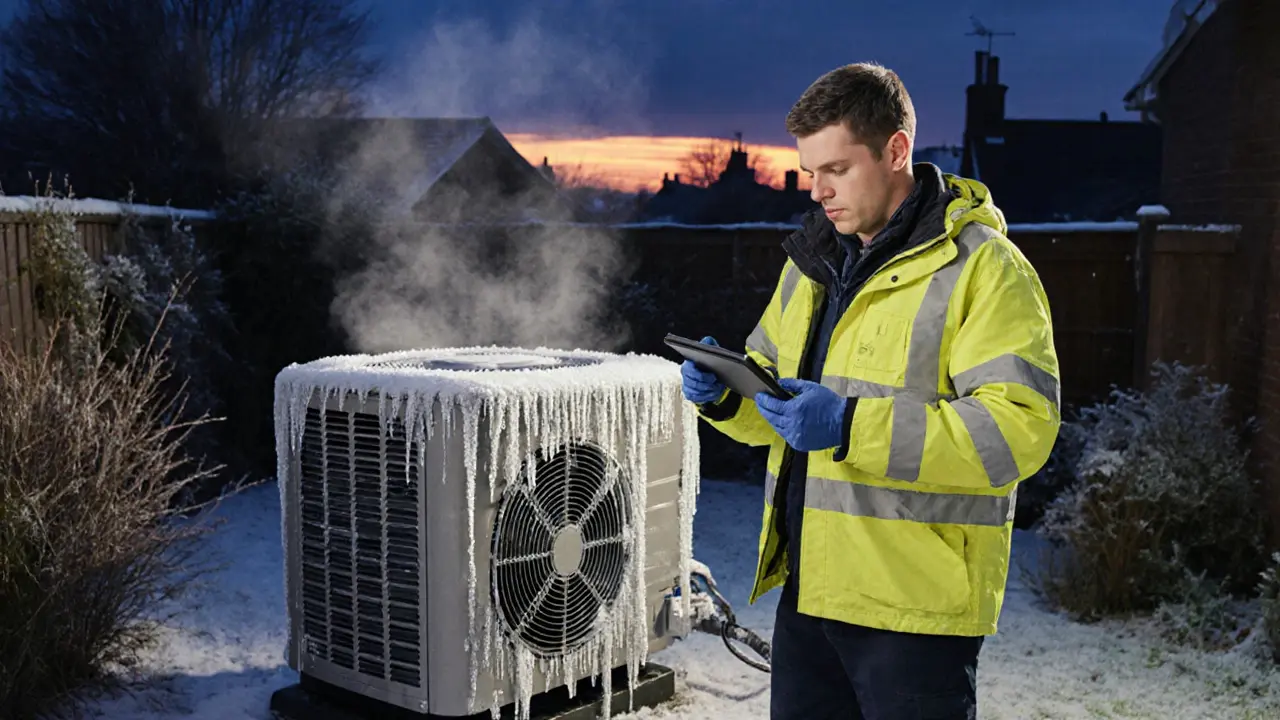
Defrost mode is a normal, automatic process your heat pump enters when ice builds up on the outdoor coil, which happens regularly in cold, humid weather.
When the system detects excessive frost (through a timer, temperature sensor, or pressure sensor depending on the model), it temporarily reverses into cooling mode to melt the ice.
During this time, the outdoor unit’s fan may stop, you might see steam rising from the outdoor unit as frost melts, and the air from your indoor vents will feel cool or room temperature. This is expected and nothing is broken.
That said, if your heat pump is not blowing warm air for more than 20 minutes, don’t assume it’s still in defrost, time it.
The key questions are whether it’s behaving normally. A normal defrost cycle wraps up in 15-20 minutes, if it goes on for half an hour or more, the defrost system may be malfunctioning.
If your system seems to be in and out of defrost every few minutes, that points to a refrigerant problem, airflow issue, or a faulty defrost control board.
And if the outdoor unit is completely encased in ice even after waiting, that’s a problem, it shouldn’t stay frozen solid.
Most modern thermostats display an “aux” or “defrost” indicator light. On the unit itself, the outdoor fan will have stopped spinning while the compressor is still running, that specific combination (compressor on, fan off) almost always means defrost. You may also hear the reversing valve click, a distinct thunk sound, when defrost begins and ends.
Heat Pump Blows Cold Air in Heat Mode: Thermostat and Mode Issues
Yes, and this is the first thing to check before suspecting anything mechanical.
Check the mode setting first. Make sure it’s set to “Heat,” not “Cool” or “Fan Only.” Fan-only mode is a common culprit, it circulates air without conditioning it, so the air feels cool or room temperature even in winter.
This is the simplest explanation for a heat pump blowing cold air in heat mode and takes seconds to rule out.
Check the set temperature vs. the current temperature. If your home is already 70°F and your thermostat is set to 68°F, the system won’t call for heat. Raise the setpoint 3-5 degrees above the current reading and wait a few minutes.
Check the fan setting. If the fan is set to “On” instead of “Auto,” it runs continuously, even when the heat pump isn’t actively heating.
During the off-cycle, the air moving through the ducts will feel cool because it’s just circulating without being heated. Switch to “Auto” so the fan only runs when the system is actively conditioning the air.
This is another scenario where the heat pump blows cold air in heat mode not because anything is broken, but because of a setting.
Look for an “Emergency Heat” mode. If your thermostat was accidentally switched to emergency/auxiliary heat only, and that backup system has a fault, you’ll get nothing useful. Return it to normal heat mode unless you’re experiencing a specific system failure your HVAC technician told you to bypass.
If a thermostat was recently replaced or the batteries died and were replaced, there’s a chance the system reverted to a default mode or a wiring issue is sending the wrong signal to the unit.
Wiring compatibility is a bigger issue than most guides admit, many smart thermostats require a C-wire (common wire) for continuous power. Without it, some thermostats “phantom power” themselves by borrowing from the heating or cooling circuit, which can cause erratic signaling, including miscommunicating the heat/cool mode to the outdoor unit.
This became widespread as homeowners self-installed smart thermostats without checking compatibility.
It’s also worth noting that heat pump thermostats are not the same as standard thermostats, a conventional thermostat wired to a heat pump can energize the reversing valve incorrectly, effectively putting the system in cooling mode while displaying “heat.”
Heat Pump Not Heating: Refrigerant and Mechanical Issues
Low refrigerant is the most common mechanical cause. Unlike a car that “uses up” oil, refrigerant doesn’t get consumed, if levels are low, there’s a leak somewhere in the system.
Signs include air that’s barely warm, ice forming on refrigerant lines or the outdoor unit, a hissing or gurgling noise near the unit, or a system that runs constantly without reaching the setpoint temperature.
Only a certified HVAC technician can legally recharge refrigerant, and importantly, the leak needs to be found and repaired, not just topped off.
A stuck reversing valve is the mechanical component that literally switches the refrigerant flow direction between heating and cooling.
It’s a solenoid-controlled valve, and it can fail in either position. If it fails stuck in cooling mode, your heat pump is not heating no matter what the thermostat says.
A clue: if your air conditioning works fine in summer but heating never works, this is worth investigating.
Compressor problems are the most expensive possibility. The compressor is the heart of the refrigerant circuit.
A failing compressor may cause the system to run without actually moving refrigerant, result in unusual noises (clanking, grinding, hard-start clicking), or simply not start at all while the fan still runs.
Outdoor unit issues, a completely frozen-over outdoor coil, bent fins blocking airflow, or a failed outdoor fan motor, all prevent heat extraction.
In extreme cold, if the outdoor unit is buried in ice or snow, the system literally cannot pull heat from the air.
Two feet of clearance around the unit and keeping it free of ice accumulation matters a lot.
A dirty indoor coil or severe filter restriction also falls under mechanical in practice, when airflow drops below a certain threshold, the system’s efficiency falls off sharply and may trigger safety shutoffs.
Non-condensables in the refrigerant circuit, air or nitrogen that enters during improper service, raises system pressure abnormally and significantly reduces heating capacity.
Similarly, on three-phase systems, if electrical phases are wired incorrectly, the scroll compressor runs in reverse: it sounds normal but produces almost no heating or cooling. Both are technician errors from a previous service visit, not system failures.
Refrigerant charge errors cut both ways. An overcharged system has elevated pressures that reduce heat transfer efficiency and can damage the compressor over time, just as an undercharged one does.
Liquid slugging compounds this, if liquid refrigerant reaches the compressor from a metering device failure or refrigerant migration during off-cycles, it can cause mechanical damage that progressively worsens heating performance before the compressor fails completely.
At that point the heat pump is not heating effectively regardless of how long it runs.
Heat Pump Not Heating: When to DIY and Basic Troubleshooting Steps
Start here before calling anyone.
Check and change the air filter first. A clogged filter is responsible for more heat pump problems than most people realize. If you can’t remember the last time you changed it, do it now.
A heavily restricted filter starves the system of airflow, reduces heat transfer efficiency dramatically, and can cause the system to short-cycle or ice up.
Check thermostat settings thoroughly, mode (Heat, not Cool or Fan), set temperature (above current room temp), fan setting (Auto, not On), and whether it’s in Emergency Heat mode accidentally.
Inspect the outdoor unit. Is it running? You should hear the compressor and see the fan spinning. Is it encased in ice?
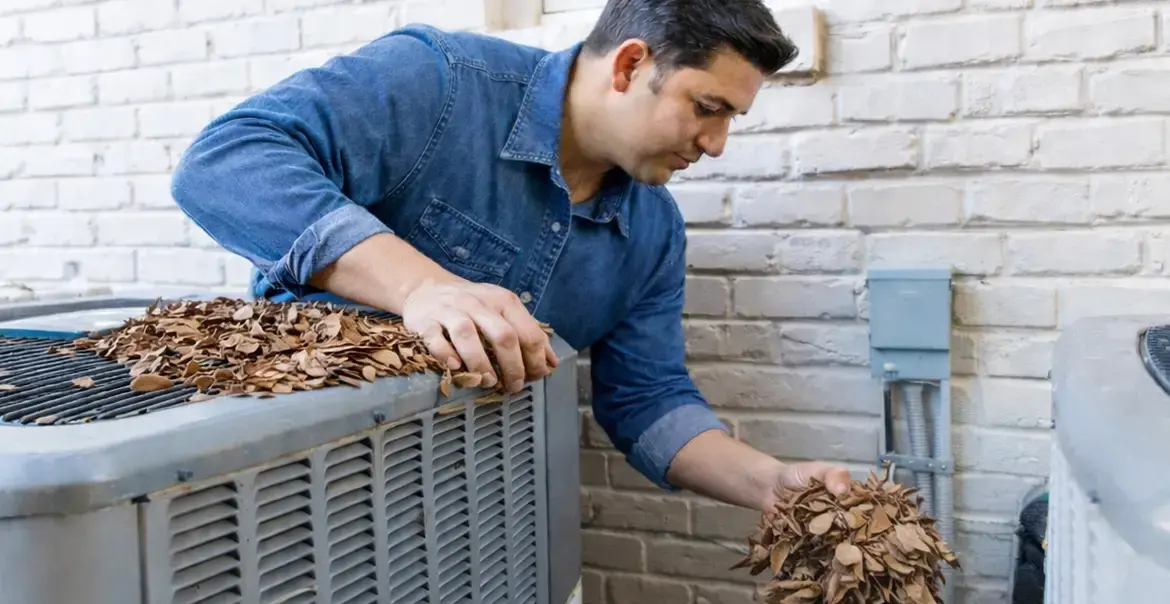
A little frost is fine; a solid ice block is not. Is there debris (leaves, insulation, trash) blocking the coil? Clear at least 18-24 inches of clearance around all sides.
Check your circuit breakers. Heat pumps often have two, one for the indoor air handler and one for the outdoor unit. If either has tripped, the system can appear to run while only half the system is actually operating.
Reset the system. Turn the thermostat off, go to your electrical panel and flip the breaker for the heat pump off, wait 30 seconds, turn it back on, then set the thermostat. Some control boards get into a fault state that a power cycle clears.
If everything seems to be running but air is cool, wait 20 minutes. If the system is in defrost mode, it will complete and return to heating.
A heat pump not blowing warm air for longer than that after a reset warrants further investigation.
Time the cycle, use your phone to time how long the system runs before shutting off. A system that shuts off after 3-4 minutes repeatedly is short-cycling, which points to a pressure trip or overheating issue. A system that runs for hours without reaching setpoint points to capacity or refrigerant issues.
Feel both refrigerant lines at the outdoor unit, with the system running in heat mode, the larger insulated line (suction line) should feel warm to the touch, not cold.
Cold suction line in heating mode is a strong indicator of low refrigerant or metering device failure. If the suction line is cold and your heat pump is not blowing warm air, refrigerant or metering issues are the likely culprit.
Check the condensate drain, in heating mode, heat pumps can produce condensation at the outdoor unit.
An indoor air handler with a blocked condensate drain can trigger a float switch that shuts the system down, which looks like a heating failure but is actually a safety shutoff.
When to Call a Pro and What They Check for Heat Pump Blowing Cold Air in Heat Mode
Call a technician when the outdoor unit is running but no heat transfer is happening after 20+ minutes, you hear hissing, bubbling, grinding, clanking, or hard-start clicking, you find ice on the refrigerant lines connecting the indoor and outdoor units (not just light frost on the outdoor coil), the system short-cycles every few minutes, the outdoor unit isn’t running at all despite the thermostat calling for heat, you smell burning or electrical odors, or you’ve done all the DIY steps and nothing has changed.
Any of these situations, especially a heat pump blowing cold air when heat is on after you’ve ruled out settings and defrost, needs professional diagnosis.
When a technician arrives, they’ll measure refrigerant pressure using manifold gauges to determine if the system is properly charged, undercharged, or overcharged.
Ask specifically whether they’re also checking superheat and subcooling measurements, pressure alone doesn’t tell you if the refrigerant charge is correct for current conditions.
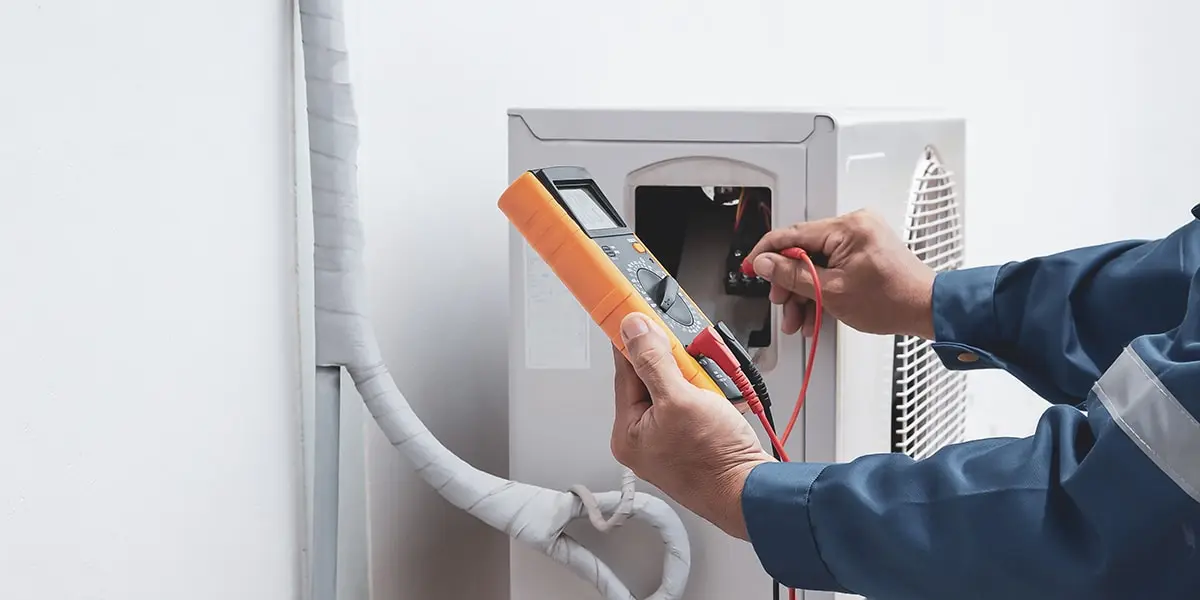
They’ll check the reversing valve, both the solenoid coil and the valve itself, to confirm it’s switching properly, test the defrost board and sensors, measure airflow across the indoor coil and check it for dirt buildup, test the compressor (amp draw, capacitor health, and whether it’s actually compressing refrigerant), and inspect electrical components including contactors, capacitors, and control wiring.
If there’s a refrigerant leak, they’ll use electronic leak detection or UV dye to locate and repair it before recharging. A good technician won’t just top off refrigerant without addressing the leak, that’s throwing money at a band-aid.
If a technician immediately recommends compressor replacement without checking the capacitor first, get a second opinion.
A failed start or run capacitor ($20-$60 part) mimics compressor failure and is one of the most common misdiagnoses in the industry. Demand a written diagnosis before authorizing any repairs, vague “needed refrigerant and a tune-up” invoices are a red flag.
How to Prevent Heat Pump Blowing Cold Air in Heat Mode
Most heat pump failures aren’t sudden, they build up over months of deferred maintenance.
Change the air filter every 1-3 months. This single habit prevents more service calls than anything else. A 1″ filter in a typical home needs monthly changes; a 4-5″ media filter can go 6-12 months. Set a phone reminder.
Schedule annual professional maintenance, ideally in the fall, before heating season. A technician will check refrigerant charge, clean coils, inspect the reversing valve, test the defrost system, check electrical components, and measure airflow.
This typically costs $100-$200 and catches problems before they strand you in a cold house. Have your auxiliary heat checked as part of this visit, if your electric strips or backup gas furnace fail, you’ll lose heating capacity on the coldest days.
Keep the outdoor unit clear year-round. Don’t let leaves, grass clippings, or mulch accumulate against or inside it, and in winter don’t let ice or heavy snow build up around it.
Keep at least a one-inch gap between the unit and any fence, wall, or shrubbery, most installs get this right initially but plantings grow.
And don’t cover the unit in winter, a common mistake: heat pumps run year-round and need airflow. Covering it traps moisture, encourages corrosion, and can cause the compressor to start against a restricted intake.
Don’t set large temperature swings or aggressive setbacks in cold weather. Heat pumps work most efficiently maintaining a steady temperature.
Dropping the setpoint 10 degrees overnight and then demanding it heat back up quickly causes excessive runtime, stresses components, and often triggers the less-efficient auxiliary heat to kick in.
Consider a smart thermostat designed for heat pumps. Not all smart thermostats handle heat pump systems correctly, look for models that specifically support “balance point” settings and auxiliary heat lockout, so the system only calls for expensive backup heat when it’s actually needed.
Log your energy bills, a heat pump losing refrigerant or developing an efficiency problem will show up as a gradual rise in winter electricity costs before any other symptom appears.
If those bills are climbing and your heat pump is not heating as efficiently as it used to, don’t wait for a full breakdown. Catching it early is far cheaper than waiting for complete failure.