Traveling to Naples with children means accepting a city that does not adapt itself – but neither does it exclude. It is a place where history is not displayed behind glass and culture is not reduced to silent visits.
Everything happens at once: voices, smells, layers of the past emerging without warning. For a family, this intensity can feel like a risk or an advantage. It depends on the pace at which the city is experienced.
Naples does not offer a sweetened version of child-friendly tourism, but a direct experience – sometimes uncomfortable, almost always stimulating.
And that is precisely its value: it forces you to observe, to ask questions, to stop when something catches your attention. In this context, children often understand more than adults expect.
A city learned by walking
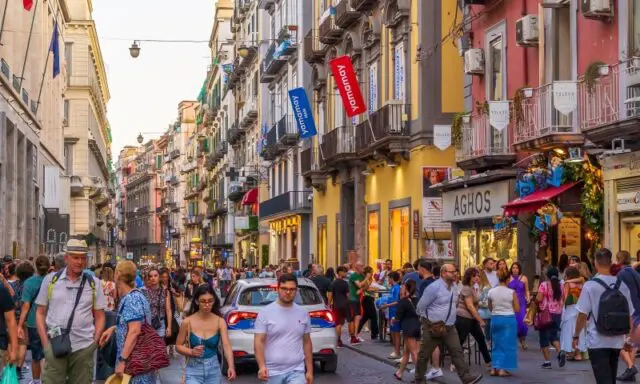
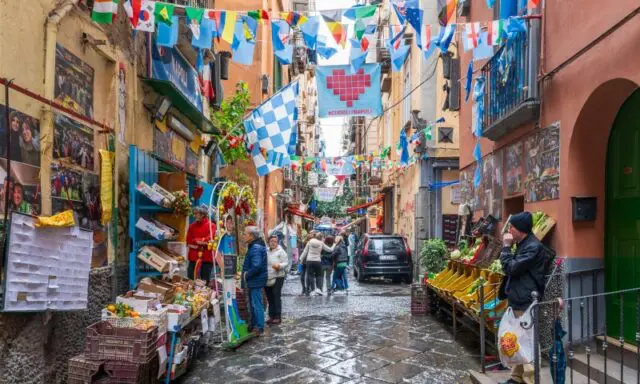
The historic center of Naples is an open manual of urban life. Narrow streets, occupied balconies, tiny workshops, and improvised shrines form a landscape that requires no long explanations.
Walking is enough. Children follow the movement: a vendor singing out prices, a ball crossing the street, a scooter stopping at the last second. There is no museum-like preservation of the environment. Everything happens in the present.
Squares such as Piazza del Plebiscito allow for a pause. Open space, pigeons, views of the sea – places where younger children can move freely without feeling they are interrupting something solemn.
Naples works this way: it alternates density and breathing space, noise and silence, surface and depth. This alternation keeps attention alert, even for those who usually get bored quickly.
Archaeology that does not feel distant
Just a few kilometers from the city, Pompeii introduces a different kind of impact. Here, archaeology is not abstract. Streets retain traces, houses display paintings, and body casts interrupt any attempt at emotional distance.
For children, the site works like a story frozen in time. There is no need to dramatize – the place does it on its own.
Many families choose to split the visit over two days to avoid overload. Staying nearby makes it possible to return early, when the site still retains a sense of calm. In this context, accommodations close to the ruins simplify logistics without becoming the focus of the trip.
In the area, it is common to encounter discreet references such as Il Tesoro Pompeiano, hotel near Pompeii ruins, mentioned more in practical conversations than in tourist narratives – useful when traveling with children and when timing matters.
Museums that engage curiosity

The National Archaeological Museum of Naples may seem like a risky choice with children, but the experience depends on the approach.
Not every section is necessary. Selecting rooms, lingering over mosaics, observing everyday objects – toys, utensils, inscriptions – turns the visit into a dialogue. Children connect more easily when they recognize familiar gestures in ancient contexts.
Cultural education here does not rely on memorizing dates, but on identifying continuities: eating, writing, playing, decorating spaces.
Archaeology stops being an accumulation of remains and becomes a relatable story. That sense of closeness often continues afterward, in questions that emerge during dinner or back at the hotel.
The sea as rest and discovery
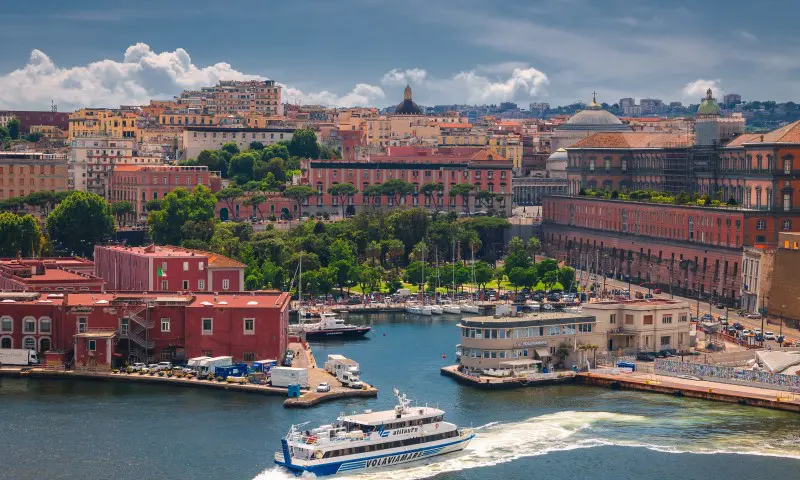
The gulf introduces another dimension. The sea slows the pace and provides a necessary pause. Walking along the Lungomare, watching Mount Vesuvius in the distance, sitting to observe boats coming and going.
It is not a scheduled excursion, but an interval. For children, the sea becomes a space for observation: currents, colors, changes in light.
From the port, ferries depart for Capri or Ischia. Visiting them is not essential, but knowing they are there expands the horizon of the trip.
Capri surprises with its abrupt geography; Ischia with its vegetation and more open beaches. Choosing one or the other depends on the time available and the accumulated fatigue.
Eating as part of the journey
In Naples, food rarely needs to be adapted for children. Pizza, pasta, simple fried dishes. Eating becomes a shared act, free of formalities.
Pizzerias function as social spaces – noisy, fast-paced. Children watch the dough being prepared, the oven in motion, the order arriving at the table without ceremony.
This everyday contact with local food avoids the feeling of merely “visiting.” You participate. And that participation leaves a mark – not as an idealized memory, but as a concrete experience.
A trip that continues afterward
Traveling to Naples with children does not guarantee constant comfort. There are long days, intense routes, moments of fatigue. But there is also a density of stimuli that rarely fades once you return home. Children remember unexpected details: a street, a fresco, a story overheard in passing.
Perhaps this is where the real appeal of the trip lies. Not in completing an itinerary, but in accepting that the city offers more than can be fully grasped.
Naples cannot be exhausted in a week, nor explained clearly. And just when it seems to have been understood, something appears that forces everything to be reconsidered.